


1. Motors and Generators Share the Same Foundation
We commonly learn that motors convert electrical energy into mechanical energy, while generators convert mechanical energy into electrical energy.
But in reality, these two machines are fundamentally the same electromagnetic device.
How they behave depends only on the direction of energy flow.
An induction motor (IM) will instantly become an induction generator (IG) when its rotor is forced to rotate faster than synchronous speed.
In other words:
- When energy flows into the machine → it works as a motor.
- When mechanical energy is fed into the shaft → it returns electricity to the grid, acting as a generator.
This duality is why induction machines are often described as two sides of one coin.
2. What Is an Induction Generator?
2.1 Definition
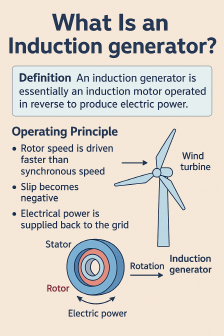
An Induction Generator (IG) is essentially an induction motor running in reverse.
When its rotor is driven above synchronous speed, the slip becomes negative, and the machine begins to deliver power back to the electrical system.
2.2 Operating Principle
Motor Mode
- AC current flows into the stator windings.
- A rotating magnetic field induces current in the rotor.
- Electromagnetic torque causes rotor rotation.
Generator Mode
- A turbine (wind, water, engine, etc.) spins the rotor faster than synchronous speed.
- The changing magnetic flux induces a rotor current.
- The rotor current flows back into the stator and supplies power to the grid.
Analogy:
A motor “eats” electricity to spin.
A generator “spits out” electricity when forced to spin.
3. Structure and Electromagnetic Mechanics
3.1 Basic Components
- Stator: Three-phase AC windings that produce a rotating magnetic field.
- Rotor: Conductive bars (aluminum or copper) forming a squirrel-cage structure.
- Slip: The speed difference between rotor speed and synchronous speed.
The sign of the slip determines the operating mode:
- Motor operation: rotor speed < synchronous speed
- Generator operation: rotor speed > synchronous speed
3.2 Excitation Requirements
Induction machines cannot create magnetic flux by themselves.
They require reactive power (magnetizing current) from either:
- The power grid (grid-connected mode), or
- A capacitor bank (stand-alone mode)
Without external excitation, an induction generator cannot produce voltage.
4. Comparison: Induction Generator vs. Synchronous Generator

4.1 Induction Generator (IG)
- Works like a motor driven in reverse
- Needs external excitation (grid or capacitor bank)
- Voltage and frequency depend on grid conditions
- Simple, rugged, inexpensive
- Excellent for renewable energy sources such as wind and micro-hydro
4.2 Synchronous Generator (SG)
- Uses DC excitation to create its own magnetic field
- Can control voltage and frequency
- Preferred in large power plants (hydro, nuclear, thermal)
- More expensive and mechanically complex
- Requires careful control and protection systems
5. Key Differences at a Glance
| Category | Induction Generator | Synchronous Generator |
| Excitation | External source (grid or capacitor) | Built-in DC excitation |
| Structure | Simple and low-cost | Complex and expensive |
| Voltage control | Difficult | Excellent |
| Best fit | Small-scale, renewables | Large power plants |
| Stability | Relies on grid | Independent & controllable |
6. Real-World Industrial Applications
1) Micro-Hydropower in Rural Communities (India)
Small rivers drive induction generators to supply power to isolated villages.
Low cost and durability make IGs ideal for rugged environments.
2) Small to Mid-Scale Wind Turbines (Denmark & Europe)
Induction generators allow wind turbines to feed energy into the grid without complex control systems.
3) Regenerative Braking in Subway Systems (Seoul Metro)
During braking, traction motors operate as generators, converting kinetic energy into electrical energy reused for station lighting and ventilation.
7. Modern Technological Advancements
7.1 Self-Excited Induction Generators (SEIG)
Capacitor banks supply magnetizing current, enabling off-grid power generation.
7.2 Variable-Speed Wind Energy Systems
Induction generators paired with power electronic converters achieve high efficiency across varying wind speeds.
7.3 Hybrid Microgrids
Solar PV, wind turbines, and induction generators combine to form stable renewable-based microgrids.
8. Future Outlook
- As global renewable energy adoption grows, induction generators remain highly relevant in wind, water, and waste-energy systems.
- Electric vehicles and smart mobility systems increasingly rely on regenerative braking, further boosting the importance of reversible induction machines.
- With advanced power electronics, IGs are overcoming past limitations related to voltage and frequency control.
Induction generators are emerging as cost-effective, durable, and sustainable energy converters for distributed generation.
9. Key Takeaways
- An induction generator is not a special machine—it’s simply an induction motor operated beyond synchronous speed.
- Its simplicity, robustness, and low cost make it a natural fit for renewable and small-scale power generation.
- Though synchronous generators dominate large power plants, induction generators excel in distributed and renewable applications.
- As the world transitions to cleaner energy, IGs will continue to play a crucial and expanding role.
induction-generator-motor-duality